Custom Candle Labels: Stickers vs. Direct Printing vs. Foil Stamping
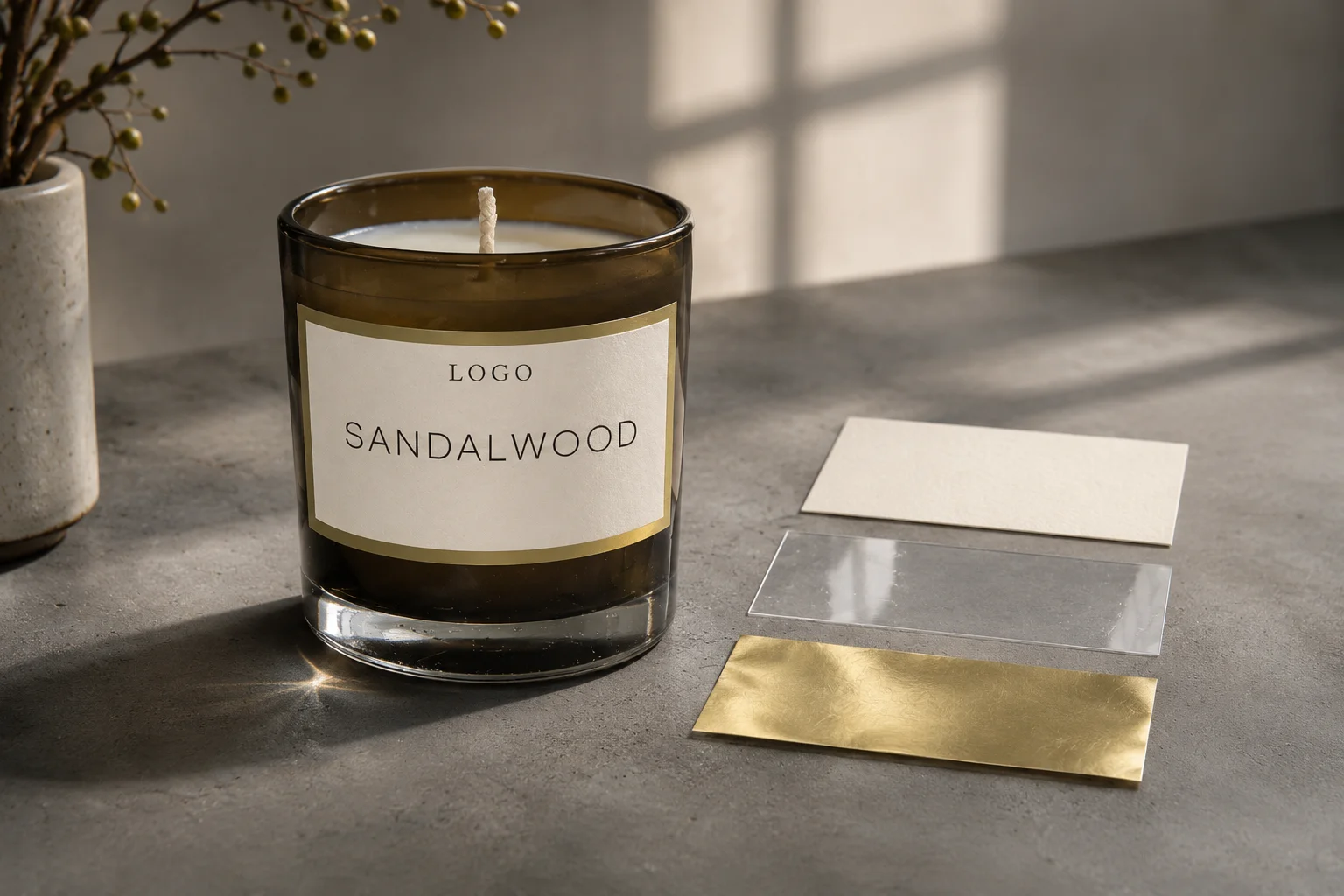
Custom candle labels are often the first branding decision buyers discuss. Yet the best decoration method depends on the vessel, artwork, quantity and desired appearance.
An adhesive label, direct print and foil accent are not always three mutually exclusive options. Foil may decorate a label or a box, while direct decoration on a vessel requires a suitable process and surface.
Start by identifying where the artwork will appear. Then compare samples and costs for that exact application.
1. Define the decoration location
Mark the front branding area, any secondary information and the required safety-label location. Keep the vessel, lid and box as separate artwork items.
Ask the supplier for usable dimensions and a template. A large curved surface may not accept the same artwork as a flat label panel.
For a coordinated range, decide which elements stay constant and which change by fragrance. This can reduce errors when several artwork versions move into production.
2. Compare the three approaches
| Approach | Visual character | What to confirm |
|---|---|---|
| Adhesive label | Defined paper or film area with flexible artwork | Material, adhesive, finish, placement and edge behavior |
| Direct printing | Artwork applied to the vessel without a separate label panel | Suitable process, colors, coverage and surface compatibility |
| Foil decoration | Reflective accent on a suitable label, box or approved surface | Foil method, artwork limits, setup and durability |
Do not assume a metallic printed color produces the same effect as foil. Likewise, a gold-colored label border does not prove which production process created it.
3. When adhesive labels make sense
Labels can be useful when a collection needs several fragrance names or a defined visual panel. Paper texture, clear film and other substrates create different appearances.
Avery's candle-label guidance describes several paper and plastic options.1 However, the selected supplier must confirm suitability for the actual vessel, temperature exposure and handling conditions.
Review a sample after application. Look at alignment, air bubbles, edge lift and visibility through clear film. Check whether the label obscures a decorative feature or exposes an unwanted seam.
Custom candle labels should also remain readable in ordinary retail light. Very small text or low contrast can undermine an otherwise attractive design.
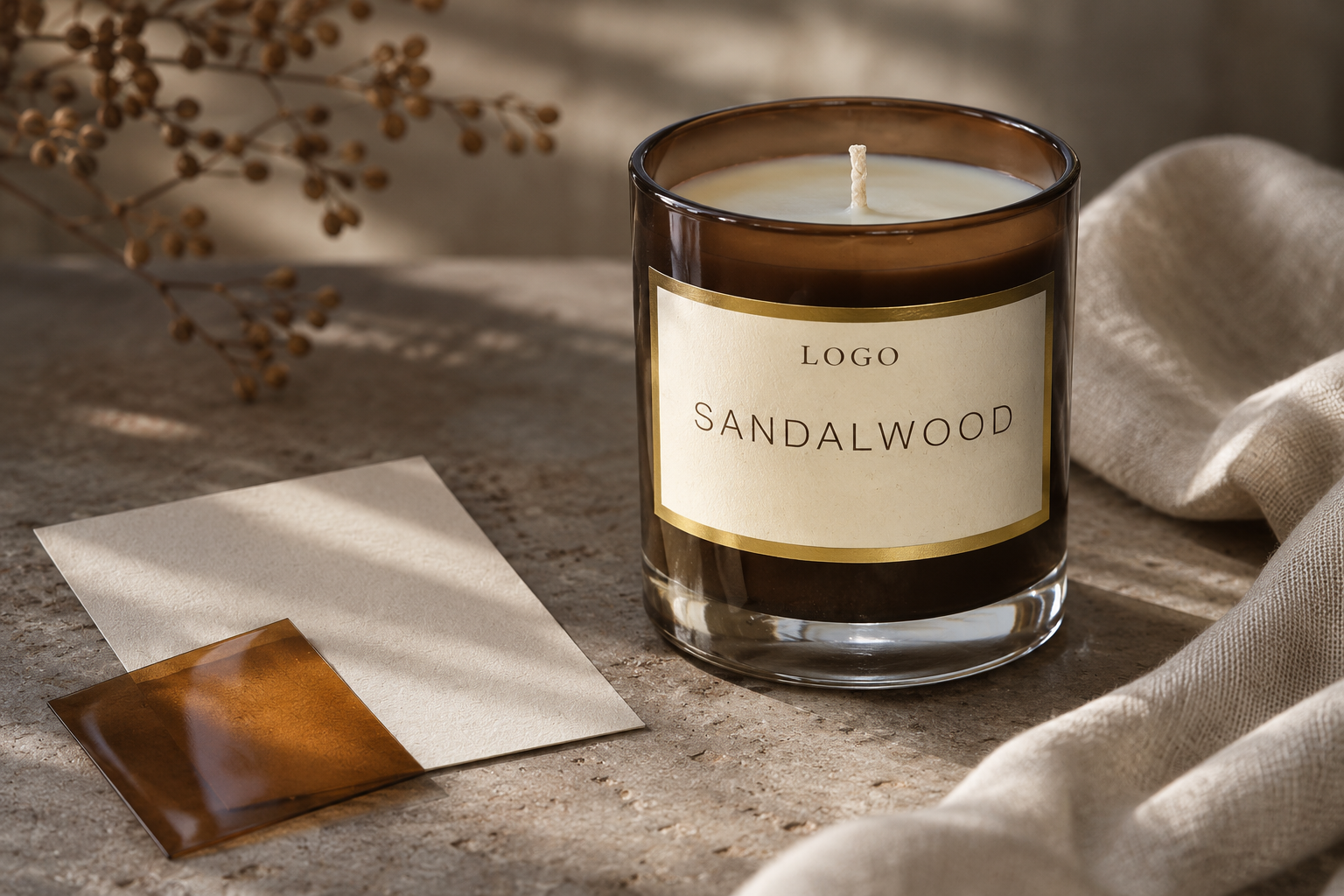
Label-material review scene. The image does not identify the production method used on the reference product.
4. When direct printing may fit
Direct printing can support a design that leaves more of the vessel visible. Ask which technique the supplier proposes and how it works on the selected finish.
Confirm the number of colors, alignment limits, printable area and whether the process needs additional preparation. Do not assume an existing print process can transfer unchanged to a different coating or shape.
Approve the decorated vessel itself. A flat digital proof cannot show how artwork appears around a curve or against tinted glass.
Also consider future changes. If each fragrance needs different artwork, ask how that affects setup, minimums and repeat orders.
5. Use foil with a clear purpose
A small reflective detail can support a premium presentation. Too many competing metallic areas can make the design harder to read.
Choose the element that deserves emphasis, such as a border or brand mark. Then ask the printer to confirm minimum line width, spacing and suitable artwork separation for its process.
Foil requirements vary by supplier and substrate. Use the actual production template rather than assuming a generic online setting applies.
Check the sample under several angles of light. The visual effect may differ from the flat artwork preview, particularly on a curved or textured surface.
6. Prepare a complete artwork handover
Send the final logo files, wording and approved dimensions. Keep fragrance versions clearly named and assign one person to approve the final set.
Include these items:
- Vector artwork where appropriate and requested by the supplier.
- Embedded or outlined fonts according to the production requirements.
- Color references and any required physical matching sample.
- Separate layers or files for special finishes if requested.
- Correct safety and market information for each product.
- A version number and final approval date.
Avery explains that bleed extends artwork beyond the trim while the safe area protects important content.2 Follow your selected printer's exact template and tolerances rather than transferring Avery's dimensions automatically.
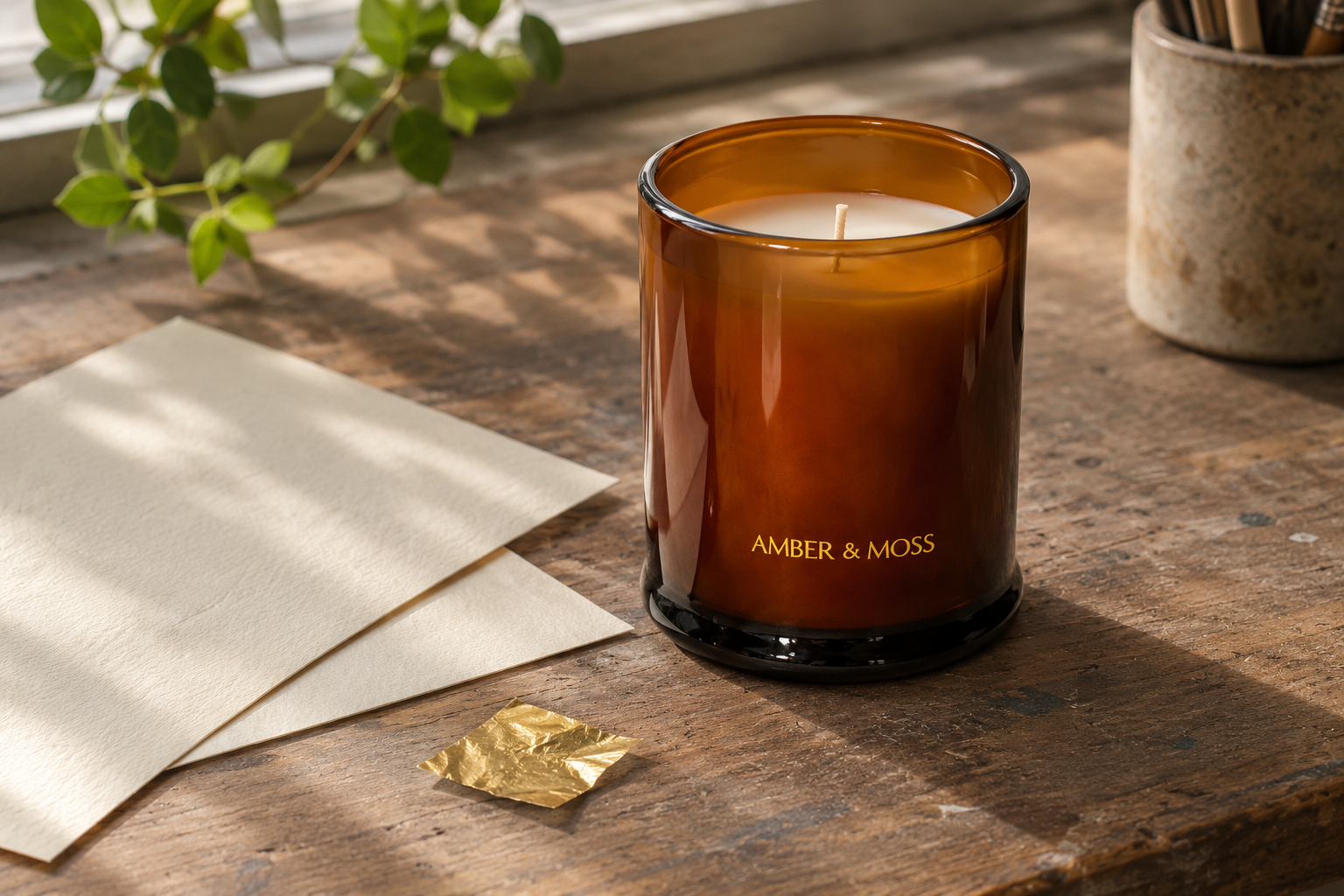
Illustrative proofing scene. Final artwork, colors and processes require a physical production sample.
7. Compare setup and repeat-order costs
Ask for one-time charges separately from recurring unit costs. Include the quantity of each artwork version and any packaging decoration.
Then compare the total at the quantity you realistically intend to order. A process that looks economical at a larger volume may be less suitable for your actual launch.
Our private label service provides a starting point for this discussion. You can also review private label and white label options before deciding how much to customize.
Frequently asked questions
Are custom candle labels less premium than direct printing?
No. Material, typography, placement and execution matter more than the method name. Compare finished samples in the intended price position.
Can foil be applied directly to every vessel?
No. The process and substrate need review. Ask whether the proposed foil treatment applies to the vessel, label or packaging.
Can I approve color from a screen?
A screen is useful for layout review, but approve a physical sample when color accuracy matters. Lighting and material can change the appearance.
Do I need separate artwork for every fragrance?
Any changing wording or product information needs its own controlled version. Confirm the supplier's file requirements and review each final proof.
Compare decoration options for your design
Send Lumelle the product link and logo artwork. Identify the branding area, preferred finish and quantity per fragrance. Our team can review suitable processes, sampling and MOQ requirements. All quotations exclude shipping costs.
References
- Avery. Candle Label Material Guide. ↩
- Avery. What Are the Bleed and the Safe Areas?. ↩