Soy Wax vs. Paraffin Wax: Which Is Better for Scented Candles?
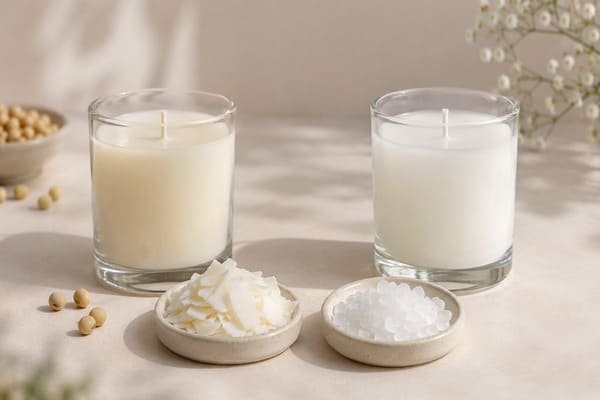
Choosing the right wax is one of the most important decisions when developing a scented candle collection. For consumers, the choice often comes down to soy wax versus paraffin wax. For candle brands, retailers, and wholesale buyers, however, the answer is more complicated.
Wax selection affects fragrance performance, burning behavior, appearance, production costs, and how a candle is positioned in the market.
Soy wax is often associated with plant-based products and a natural aesthetic. Paraffin wax is widely used for its fragrance performance and formulation flexibility. Both can produce quality scented candles when paired with suitable fragrances, wicks, and containers.
So, which is better?
The best candle wax is not necessarily the one with the most appealing marketing claims. It is the one that delivers the performance, appearance, and cost structure your product requires.
This guide compares soy wax and paraffin wax from both a product and a wholesale purchasing perspective.
What Is the Difference Between Soy Wax and Paraffin Wax?
Before comparing performance, it helps to understand what these materials are and how they are used.
What Is Soy Wax?
Soy wax is a vegetable-based wax produced from soybean oil, which is processed to achieve the consistency required for candle making.
It is commonly used in container candles and is particularly popular among brands that emphasize plant-derived ingredients and minimalist product design.
Soy wax typically has an opaque, creamy appearance. However, different grades have different melting points, fragrance capacities, and surface characteristics.
It is also important to distinguish between 100% soy wax and soy wax blends.
A product described as a "soy candle" may contain additional waxes or additives, depending on its formulation. Wholesale buyers should confirm the actual composition before making specific ingredient claims.
What Is Paraffin Wax?
Paraffin wax is a refined petroleum-derived wax that has been widely used in candle manufacturing for decades.
It is available in different grades and can be formulated for container candles, pillars, votives, and other candle formats.
Paraffin is valued for its compatibility with many fragrance formulations, its ability to produce strong scent throw, and the range of finishes achievable through processing.
It is also commonly used in wax blends to balance fragrance performance, appearance, and manufacturing characteristics.
According to the CandleScience Wax Guide, selecting candle wax involves several considerations, including the intended candle type, fragrance performance, appearance, and burning characteristics.[^1]
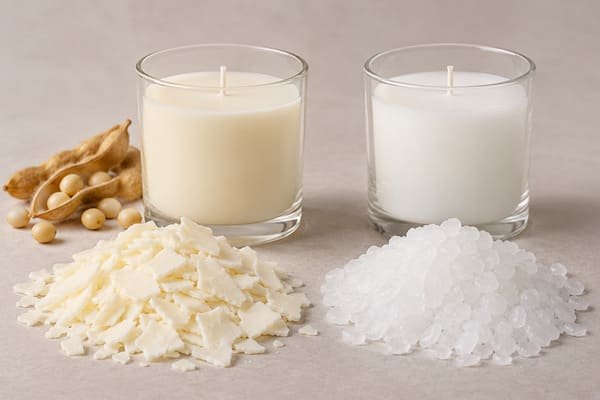
Soy wax and paraffin wax materials used in scented candle formulations.
Soy Wax vs. Paraffin Wax: A Quick Comparison
The following table summarizes their typical characteristics.
| Feature | Soy Wax | Paraffin Wax |
|---|---|---|
| Raw material | Soybean oil | Refined petroleum-derived wax |
| Material positioning | Plant-derived | Conventional mineral-derived wax |
| Appearance | Often creamy and matte | Can produce smooth or glossy finishes |
| Fragrance throw | Good with a suitable formulation | Often favored for strong hot throw |
| Burn time | Depends on wax grade, wick, and design | Depends on wax grade, wick, and design |
| Surface behavior | May develop frosting or uneven tops | Often easier to achieve a uniform finish |
| Color performance | Often softer or more muted | Frequently suitable for vivid colors |
| Cost | Depends on grade, sourcing, and formulation | Depends on grade, sourcing, and formulation |
| Common applications | Container candles, natural-positioned collections | Container candles, pillars, fragrance-led collections |
These are general tendencies rather than guaranteed performance differences.
Two candles made from the same wax category can behave differently if they use different fragrances, wicks, or containers.
For wholesale buyers, the finished candle should always be evaluated rather than judging the wax material alone.
1. Which Wax Has Better Fragrance Throw?
Fragrance performance is often the first consideration when selecting wax for a scented candle.
However, fragrance performance involves two different characteristics.
Cold throw describes the fragrance released when a candle is unlit.
Hot throw describes the fragrance released while the candle is burning.
Both matter commercially.
A candle with appealing cold throw may attract attention when a customer removes its lid in a retail store. Strong hot throw, meanwhile, can influence the customer's experience after purchase.
Soy Wax Fragrance Performance
Soy wax can deliver good fragrance performance when the wax, fragrance oil, and wick are properly matched.
However, the results vary across formulations.
Certain soy waxes may require adjustments to fragrance concentration, wick selection, or production conditions to achieve the desired performance.
This is particularly important for brands developing candles with subtle botanical or complex fragrance profiles.
Paraffin Wax Fragrance Performance
Paraffin wax is frequently selected for fragrance-focused candles because many formulations provide strong hot throw.
It can be particularly useful when a product is designed around a noticeable fragrance experience.
Nevertheless, paraffin does not automatically outperform every soy formulation.
Fragrance oil compatibility, wick performance, and container geometry all influence the final result.
What Should Wholesale Buyers Test?
Instead of choosing wax based on general claims, request samples with comparable specifications.
Evaluate:
- Cold throw before lighting.
- Hot throw in a consistent testing space.
- Fragrance character during different burning stages.
- Changes in fragrance performance as the candle burns down.
- Overall burning behavior and visible soot.
For a fair comparison, keep the fragrance direction, wax fill weight, and container format consistent where possible, while allowing each wax formulation to use a properly matched wick.
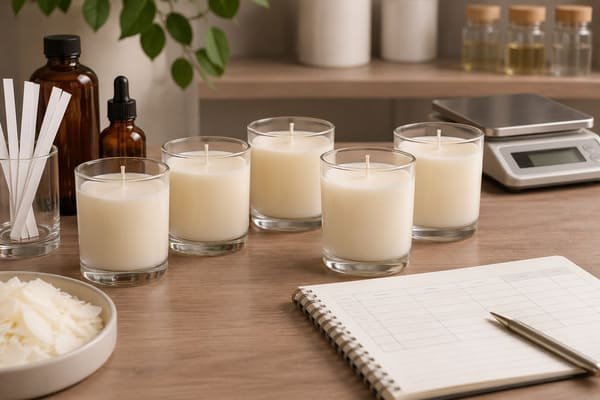
Evaluating fragrance compatibility and candle formulations before wholesale production.
Buyer recommendation: If fragrance strength is your primary selling point, compare finished soy and paraffin formulations under the same test conditions before approving production.
2. Does Soy Wax Burn Longer Than Paraffin Wax?
One of the most common claims about soy candles is that they burn longer than paraffin candles.
This can be true for some formulations, but it is not a universal rule.
Burn time depends on several factors:
- Wax formulation and melting characteristics.
- Wick material, size, and construction.
- Candle diameter and container shape.
- Fragrance concentration.
- Total wax fill weight.
- Burning conditions.
For example, a 200 g soy candle and a 200 g paraffin candle should not be expected to have identical burn times simply because their weights are the same.
A properly optimized paraffin candle may outlast a poorly matched soy candle, and the reverse is also possible.
The National Candle Association emphasizes that well-made candles using different wax types can deliver comparable performance when correctly formulated.[^2]
Why Burn Time Matters for Wholesale Orders
For retail brands, burn time can influence how a product is priced and positioned.
For hotels and commercial buyers, it may also affect replacement frequency and operating costs.
Therefore, buyers should request burn-time information for the specific finished product, not a general estimate based only on wax type.
Before approving a candle collection, consider asking your supplier:
- What is the finished candle's net wax weight?
- Which wax formulation and wick are used?
- Has the finished product undergone burn testing?
- What burn-time information is available for this exact specification?
The testing should consider the candle's full usable life, rather than relying on observations from the first few hours.
3. Appearance: Which Wax Is Better for Luxury Candle Designs?
A candle is not only a fragrance product. It is also a decorative object.
For luxury candle brands, the appearance of the wax can be nearly as important as the glass vessel, label, or packaging.
Soy Wax: A Soft, Natural-Looking Finish
Soy wax commonly produces an opaque, creamy surface that works well with minimalist and neutral-toned candle collections.
However, one characteristic buyers should understand is frosting.
Frosting appears as whitish crystalline patterns on the surface or sides of soy wax.
It occurs as the wax crystallizes and is generally a cosmetic issue rather than evidence that the candle cannot function properly.
Some soy formulations may also develop uneven or slightly rough surfaces after burning.
These characteristics are worth considering when developing candles in transparent glass containers, where the wax remains highly visible.
Paraffin Wax: Flexible Visual Finishes
Paraffin formulations can produce smooth surfaces and support a wide variety of colors.
This can make them attractive for decorative candle collections requiring consistent color presentation or a particular visual finish.
However, surface appearance still depends on manufacturing conditions, additives, cooling, and the specific formulation.
Which Appearance Works Best for Your Brand?
Consider two different product concepts.
Collection A: Minimalist Botanical Candles
The collection uses clear or amber glass, cream-colored wax, and simple labels.
A suitable soy formulation may support the desired plant-derived material positioning and understated visual style.
Collection B: Decorative Luxury Candles
The collection uses colored wax, highly decorative glass, and carefully coordinated packaging.
A paraffin formulation or optimized wax blend may be worth testing to achieve the required finish and color consistency.
Neither choice is inherently more luxurious.
Luxury positioning comes from the quality and consistency of the complete product, not the wax name alone.
For brands exploring different container styles, Lumelle offers a range of wholesale scented candle designs that can serve as starting points for product selection and customization.
4. Which Wax Is Better for Shipping and Storage?
A candle that performs well during sampling must also remain presentable during transportation, warehousing, and retail distribution.
This is especially important for international wholesale orders.
Consider the Melting Point
Both soy wax and paraffin wax are available in grades with different melting characteristics.
Some softer container-wax formulations may be more sensitive to elevated temperatures.
Potential problems during warm-weather storage or transportation include:
- Surface softening or deformation.
- Changes in wax appearance.
- Fragrance oil separation.
- Visible changes around the container walls.
These are not problems exclusive to one wax category.
A higher-melting formulation may be preferable in certain shipping conditions, but the complete finished product must still be evaluated.
Consider the Destination Market
A retailer distributing candles across Northern Europe may face different storage and transport conditions from a business supplying markets in the Middle East or Southeast Asia.
Before ordering, buyers should discuss:
- Expected transportation temperatures.
- Seasonal shipping conditions.
- Warehouse and retail storage environments.
- Container and packaging protection.
- Any available temperature-stability testing.
For overseas distribution, selecting the wax is only one part of preventing product damage.
The container, cushioning materials, retail box, and shipping carton should also be reviewed.
5. Soy Wax vs. Paraffin Wax: Which Is More Cost-Effective?
For wholesale buyers, the cheapest raw material does not always produce the most economical finished candle.
Paraffin is often considered a cost-competitive option in candle manufacturing, but actual prices vary by grade, supplier, location, and market conditions.
Soy wax costs also depend on its origin, formulation, and procurement volume.
A meaningful cost comparison should examine the finished product rather than only the price per kilogram of wax.
What Determines the Final Candle Cost?
| Cost Component | Why It Matters |
|---|---|
| Wax | Material grade, formulation, and consumption |
| Fragrance | Fragrance type, concentration, and compatibility |
| Wick | Wick configuration and testing requirements |
| Container | Material, capacity, finish, and decoration |
| Packaging | Labels, boxes, inserts, and protective materials |
| Production | Processing, quality control, and manufacturing requirements |
| Logistics | Carton dimensions, weight, freight, and destination |
For example, a brand may save money by choosing a lower-cost wax but spend more on fragrance adjustments, production changes, or additional testing.
Another formulation may have a higher material cost but provide a finish that better supports the intended retail positioning.
Evaluate Cost Per Sellable Candle
A practical comparison should include:
Finished unit cost + packaging + logistics + expected losses = approximate landed cost per sellable unit
This is a simplified purchasing framework. Import duties, taxes, and additional distribution expenses may also need to be included.
A better commercial question is therefore:
Which formulation delivers the required product quality at a cost that supports our target selling price and margin?
That is more useful than simply asking which wax is cheaper.
6. Is Soy Wax Safer or More Eco-Friendly Than Paraffin Wax?
Soy wax is derived from a plant-based feedstock, while paraffin wax originates from petroleum.
This distinction may matter to brands developing a specific material identity.
However, it does not automatically establish that one finished candle is safer or has a lower overall environmental impact.
Safety Depends on the Finished Candle
Candle emissions and burning behavior are influenced by the complete formulation and how the product is used.
The National Candle Association explains that different quality candle waxes can be used to produce candles that burn cleanly when properly formulated.[^2]
It is therefore misleading to claim that all soy candles are soot-free or that all paraffin candles are unsafe.
Environmental Claims Need Evidence
Plant-based origin is a material characteristic, but environmental impact also depends on factors such as:
- Raw material sourcing.
- Agricultural and processing practices.
- Manufacturing energy use.
- Packaging materials.
- Transportation.
- End-of-life disposal.
Brands should be careful about broad claims such as "completely sustainable," "zero emissions," or "100% eco-friendly" unless they have appropriate evidence.
Similarly, a candle containing soy wax should not automatically be marketed as 100% soy wax.
Safety Standards Still Matter
For candles intended for the US market, buyers can consult the US Consumer Product Safety Commission's guidance on candle products and applicable requirements.
The CPSC also identifies relevant voluntary ASTM standards covering candle fire safety, safety labeling, and candle glass containers.[^4]
Requirements can vary by destination market.
Before placing a wholesale order, confirm which labeling, safety, and product documentation requirements apply to your intended market.
7. What About Soy-Paraffin Wax Blends?
Choosing between pure soy wax and pure paraffin wax is not always necessary.
Many candle manufacturers use blended wax formulations to achieve specific product characteristics.
For example, a soy-paraffin blend may be developed to balance:
- Fragrance performance.
- Surface appearance.
- Wax hardness.
- Container adhesion.
- Burning characteristics.
- Manufacturing consistency.
The exact benefits depend on the proportions and additional ingredients.
A blend is not automatically superior to a single-wax formulation. It must be evaluated as a complete candle.
For private label projects, buyers should confirm whether the proposed formulation is pure soy, paraffin, or a blend.
This information is important for product descriptions, ingredient-related marketing claims, and repeat-order consistency.
8. How Should Candle Brands Choose the Right Wax?
The best starting point is your product strategy.
Rather than selecting a wax first and building the product around it, define the desired customer experience and commercial requirements.
For Plant-Based Candle Collections
Soy wax may be an appropriate starting point if your brand emphasizes plant-derived materials, soft visual finishes, and a natural-inspired product identity.
Request the wax composition and test the finished candle before deciding on marketing claims.
For Fragrance-Focused Collections
If fragrance throw is the primary selling point, compare paraffin formulations, soy formulations, and suitable blends.
Prioritize actual scent performance rather than assumptions about the material.
For Luxury Gift Collections
Focus on the complete presentation.
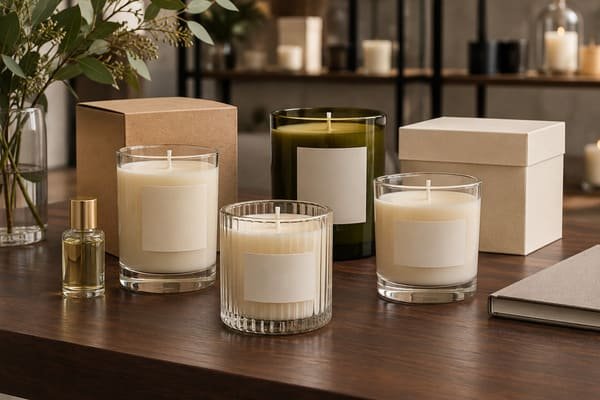
Wax surface, vessel design, fragrance, label quality, and packaging should support the same brand positioning.
The chosen wax should work with the intended appearance and remain consistent across production batches.
For Large Wholesale Orders
Prioritize repeatability.
A successful candle formulation should be documented so that future orders can reproduce the approved product.
This includes the wax grade, fragrance, wick, net weight, container, and packaging specification.
Buyers comparing available formats can start with Lumelle's wholesale candle programme before discussing specific requirements.
9. A Practical Wax Selection Checklist for Wholesale Buyers
Before approving production, use the following checklist to compare candle samples.
| Evaluation | What to Confirm |
|---|---|
| Wax composition | Pure wax or blend; actual material specification |
| Fragrance | Cold throw and hot throw |
| Burning performance | Burn behavior throughout the candle's life |
| Surface appearance | Smoothness, frosting, cracks, or other visible changes |
| Container compatibility | Glass adhesion, stability, and thermal performance |
| Storage stability | Appearance under expected storage and shipping conditions |
| Packaging | Product protection and retail presentation |
| Documentation | Specifications, test information, and market-specific labeling |
| Price | Finished unit cost and logistics |
| Repeat orders | Ability to reproduce the approved specification |
Compare Samples Under Consistent Conditions
When evaluating multiple formulations:
- Use comparable candle sizes and container formats.
- Keep fragrance selection consistent where practical.
- Allow each formulation to use an appropriate, tested wick.
- Evaluate fragrance and appearance under comparable conditions.
- Review burn performance across the candle's full usable life.
- Record the approved specifications for future production.
CandleScience's burn testing guidance highlights the importance of testing the complete candle, including its wax, wick, fragrance, and container combination.[^3]
For buyers developing a new product line, this process can help prevent expensive changes after production has already started.
Frequently Asked Questions
Is soy wax better than paraffin wax for scented candles?
Not necessarily. Soy wax is often preferred for its plant-derived origin and creamy appearance, while paraffin is frequently selected for fragrance performance and formulation flexibility. The better choice depends on the finished candle's intended use and tested performance.
Do soy candles always burn longer than paraffin candles?
No. Burn time depends on the wax formulation, wick, fragrance, container, and testing conditions. Buyers should compare the burn-time results of specific finished candles rather than relying on general claims.
Does paraffin wax have a stronger scent than soy wax?
Many paraffin formulations offer strong hot throw, but well-formulated soy candles can also provide good fragrance performance. Testing is necessary to establish which formula works best for a particular fragrance.
Can a candle contain both soy wax and paraffin wax?
Yes. Soy-paraffin blends are used in candle manufacturing to achieve specific performance characteristics. Buyers should confirm the formulation and avoid describing a blended candle as 100% soy wax.
Which wax is best for private label candles?
Both soy and paraffin wax can be used for private label collections. The selection should reflect the brand's positioning, desired appearance, fragrance performance, target price, and destination market.
What should I request from a candle supplier before placing a wholesale order?
Ask for the wax composition, net wax weight, fragrance specification, wick information, container dimensions, available burn-test information, packaging details, minimum order quantity, production lead time, and applicable product documentation.
Conclusion: Choose the Wax That Fits Your Candle Collection
The soy wax versus paraffin wax debate does not have a single winner.
Soy wax can be a good choice for collections built around plant-derived ingredients and a soft, understated appearance.
Paraffin wax can be an effective option for fragrance-led products and collections requiring particular visual or manufacturing characteristics.
Blended waxes offer another possibility when a product needs a balance of multiple characteristics.
For candle brands, retailers, and wholesale buyers, the most reliable approach is to compare actual formulations, evaluate samples, and approve a documented product specification before placing a bulk order.
The right wax should support your brand identity while meeting the performance, quality, and commercial requirements of the finished candle.
Develop Your Scented Candle Collection with Lumelle
Lumelle supplies scented candles for wholesale and private label projects, with wax, fragrance, container, and packaging options reviewed according to each product.
Our available wax options include soy, paraffin, and palm wax, with limited beeswax production. Final formulations and customization possibilities are confirmed for individual projects.
You can explore our scented candle collection or learn more about private label candle development.
If you are planning a new candle collection, share your preferred wax, fragrance direction, container design, order quantity, and destination market.
Contact Lumelle to discuss your candle requirements and request samples.
References
[^1]: CandleScience. Candle Wax Guide: Choosing the Right Wax for Candles. Information on wax categories, formulation differences, fragrance performance, and applications.
[^2]: National Candle Association. Illuminating the Truth: Why Candles Are Safe to Use. Industry information on candle wax types, combustion, and safety.
[^3]: CandleScience. How to Conduct a Basic Burn Test. Guidance on evaluating finished candles, wick performance, burn behavior, and testing procedures.
[^4]: U.S. Consumer Product Safety Commission. Candles Business Guidance. US candle requirements and references to relevant voluntary safety standards.